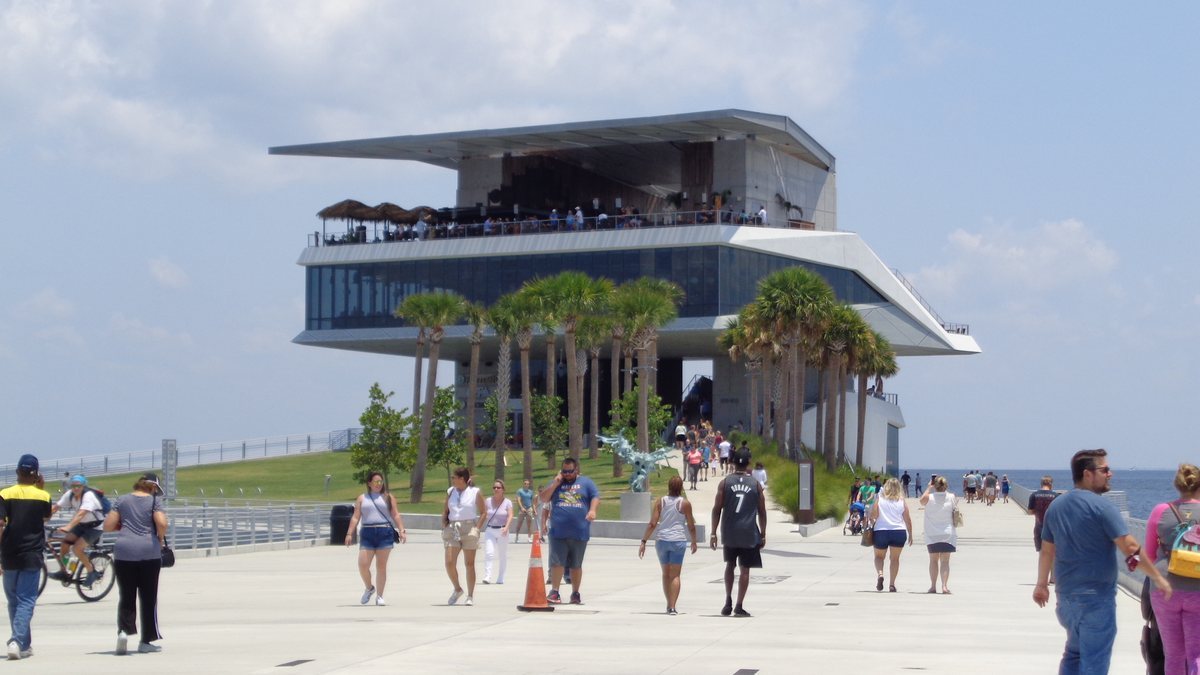
Marinas we dive
St. Petersburg Municipal Marina, and the water it lives in.
Basin since 1889Tampa BayCity-owned
Marinas we dive
The water
On 1 January 1914, Tony Jannus flew the world's first scheduled airline flight out of the Central Yacht Basin, across Tampa Bay to Tampa. It left from this water.
The basin exists because of a decision the city made early. Peter Demens had run rail track out over a 3,000-foot pier in 1889, into twelve feet of water, so ships could unload straight into boxcars. Through the 1890s the port shipped roughly three million pounds of fish a year.
Then city leaders looked at Tampa's growing industrial port and decided not to compete. They committed the shoreline to public parks instead. That is why downtown St. Petersburg has a municipal yacht basin and a waterfront park system rather than container cranes.
8.2 miles from Blind Pass. Very little of that tide arrives here, and a hot still summer will show you exactly what that means.
St. Petersburg Municipal Marina, St. PetersburgSt. Petersburg Municipal Marina lies about 8.2 miles from Blind Pass, with Pass-a-Grille Channel roughly 9.1 miles off. It is a long way from any inlet, and that distance is the single best predictor of how fast a hull fouls here.
This is some of the least-flushed water we work. Warm, slow, and nutrient-loaded through summer, it favours algae over barnacle and can put a real drag layer on a clean hull in a matter of weeks.
As a city-owned facility it takes a broad mix of boats rather than one class, which means the fouling picture varies more berth to berth than at a private marina with a narrower fleet.
Timeline
John C. Williams of Detroit purchases the land that becomes downtown St. Petersburg.
Peter Demens routes the Orange Belt Railway to the new city. Lore has the two men flipping a coin for naming rights; Demens wins and names it after St. Petersburg, Russia.
Demens runs track out over a 3,000-foot pier reaching 12 feet of water, so deep-draft ships can unload straight into boxcars.
The town incorporates with a population of roughly 300.
The port ships around three million pounds of fish a year.
City leaders decline to compete with Tampa's industrial port and commit the waterfront to public parks instead — the decision that still defines the shoreline.
Tony Jannus flies the world's first scheduled airline flight from the Central Yacht Basin across the bay to Tampa.
Dedicated on Thanksgiving Day before a crowd of 10,000, extending 1,452 feet into the bay with a streetcar line running to the casino at its head.
Things worth knowing
Distance to the nearest inlet is the strongest single predictor of fouling rate. At 8.2 miles from Blind Pass, with Pass-a-Grille Channel a further 9.1 miles off, this berth sits largely outside it.
City-owned, on the downtown waterfront. St. Petersburg, on Tampa Bay, 8.2 miles inside Blind Pass — well within our regular run.
Growth in Pinellas is not linear, and at 8.2 miles in the seasonal swing is at its most extreme, because still water heats fastest. A cadence set for August will be wrong in January.
Bare metal fouls faster than painted surface everywhere on this coast, and even in slow water it leads the hull. Props, shafts and struts usually signal the timing before the paint does.
Manatees, dolphins and grass beds share Tampa Bay. Method matters as much as schedule — media matched to the paint, and nothing scoured into the bottom.
642 Google reviews at 4.6 stars puts this among the busier facilities we cover, and busier basins mean more hull traffic moving growth around.
From the diver
Full-salinity water with steady exchange means hard growth, not just soft. Barnacles set aggressively on bare metal, and a prop can load up well before the hull looks like it needs attention.
Tidal current keeps the water moving, which helps the topsides and hurts the running gear — anything unpainted spends its life in a constant supply of new larvae.
Zincs go faster in this water than owners expect. Checking anode condition on every visit is worth more here than almost anywhere else in Pinellas.
Gallery


We dive Tampa Bay and know how it behaves through the season. Tell us the boat and the slip and we'll send a number and a cadence that fits the water it actually sits in.