Marinas we dive · Tarpon Springs
Port Tarpon Marina, and the water it lives in.
Sponge capital since 1905Anclote RiverWorking waterfront
Marinas we dive · Tarpon Springs
The water
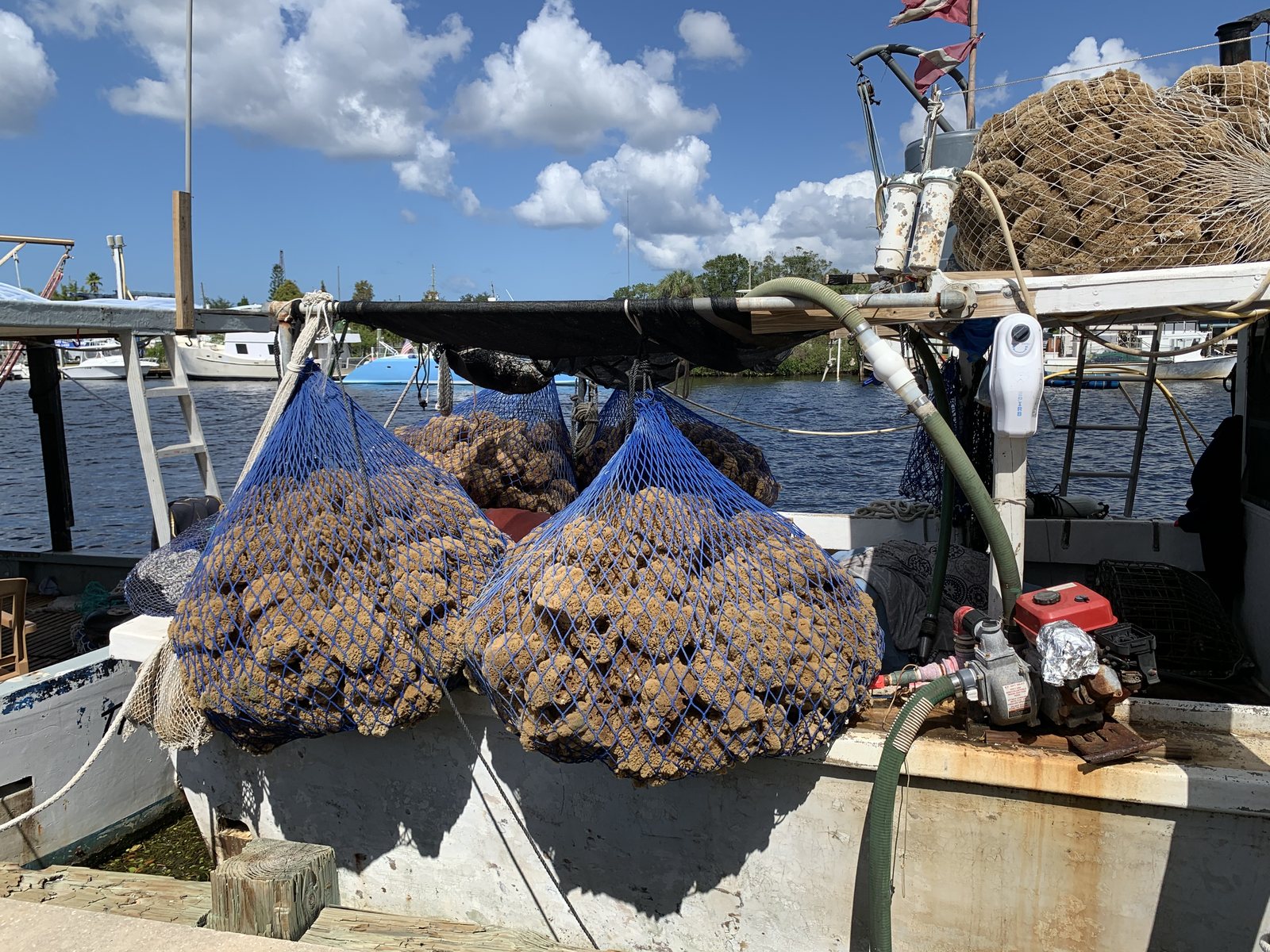
Tarpon Springs is the one marina town on this coast where the industry came first and everything else arranged itself around it. Sponge had been harvested off Florida's Gulf coast for decades by hooking it from the surface. What changed here was the arrival, from 1905 onward, of Greek divers from the Dodecanese — men who already knew how to work a hard-hat rig on the bottom.
They brought the deep-water method with them, and the Anclote River became the base for a fleet that made this the sponge capital of the United States. The town still has the highest proportion of Greek-American residents of any city in the country, and Dodecanese Boulevard is named for the islands those first crews came from.
The fleet is not a museum piece. Five vessels working out of these docks are listed on the National Register of Historic Places under a dedicated multiple-property submission for Tarpon Springs sponge boats: the Duchess, the George N. Cretekos, the N.K. Symi, the St. Nicholas III and the St. Nicholas VI. All five were entered on 2 and 3 August 1990. The George N. Cretekos was built in 1941 by the Samarkos Brothers. Shrimpers work alongside them.
For anyone who works underwater for a living, that lineage is not decoration. This is the stretch of Florida coast where diving was the economy.
At 3.8 miles in from the Anclote River mouth, the flushing has largely spent itself. What grows here is soft, and soft growth is forgiving until it isn't.
Port Tarpon Marina, Tarpon SpringsPort Tarpon Marina lies about 3.8 miles from the Anclote River mouth, with Hurricane Pass roughly 8.9 miles off. It sits back from the inlet, and that distance is the single best predictor of how fast a hull fouls here.
At this distance the tidal push has largely spent itself. Water warms, turnover slows, and the balance shifts toward soft growth — slime and grass rather than heavy shell.
A private marina with a settled fleet gives us the most useful thing possible: the same hulls over time, so the cadence gets sharper with every visit.
Timeline
Sponge is harvested off the Gulf coast with poles and hooks from small boats. No one is going down after it.
Greek divers begin arriving from Kalymnos, Symi and Halki, bringing hard-hat deep-water technique with them.
The Anclote fleet makes Tarpon Springs the center of the American sponge trade. Packing houses line the river.
Captain Michael J. Billiris founds the boat line on Dodecanese Boulevard. The Billiris family still runs it — one of the longest continuously operating attractions in Florida.
Built by the Samarkos Brothers — one of the boats that would later earn National Register listing.
The Tarpon Springs Historic District is added to the National Register on 6 December, four months after the sponge boats.
Five sponge boats are entered on the National Register on 2 and 3 August under the Tarpon Springs Sponge Boats multiple-property submission.
The docks at Dodecanese Boulevard remain a working waterfront, not a reconstruction.
Things worth knowing
Distance to the nearest inlet is the strongest single predictor of fouling rate. At 3.8 miles from the Anclote River mouth, with Hurricane Pass a further 8.9 miles off, this berth sits at the edge of it.
On the Anclote, downriver of the sponge docks. Tarpon Springs, on the Anclote River, 3.8 miles inside the Anclote River mouth — well within our regular run.
Growth in Pinellas is not linear, and at 3.8 miles in the seasonal swing is pronounced but predictable. A cadence set for August will be wrong in January.
Bare metal fouls faster than painted surface everywhere on this coast, and even in slow water it leads the hull. Props, shafts and struts usually signal the timing before the paint does.
Manatees, dolphins and grass beds share the Anclote River. Method matters as much as schedule — media matched to the paint, and nothing scoured into the bottom.
455 Google reviews at 4.4 stars puts this among the busier facilities we cover, and busier basins mean more hull traffic moving growth around.
From the diver
River influence drops the salinity, and barnacles do not care for that. Boats kept up the Anclote generally carry far less hard shell than the same hull on the open bay.
What the fresh water does not stop is soft growth. Slime and grass are indifferent to salinity, and they cost speed and fuel exactly the same.
Tannic water also means lower visibility, so documentation matters more here. Photos and video from the dive are how you actually know what the bottom looks like.
Gallery


We dive the Anclote River and know how it behaves through the season. Tell us the boat and the slip and we'll send a number and a cadence that fits the water it actually sits in.