Marinas we dive · St. Petersburg
Maximo Marina, and the water that fights back.
Est. 196044 AcresSpring-Fed BasinBoca Ciega Bay
Marinas we dive · St. Petersburg
The long story
In 1843 a fisherman named Antonio Maximo Hernandez was granted land at the southern tip of the Pinellas peninsula for service during the Second Seminole War. He built a fishing rancho there — one of the first in Florida — salting mullet and roe and running it south to Cuba. Three years later William Bunce joined him in the trade, and for a brief window this quiet corner of Boca Ciega Bay was a working port with a line straight to Havana.
It lasted five years. On September 25, 1848, the storm remembered as the Great Gale came across the peninsula. The water rose to treetop level. The rancho, the boats, and everything the two men owned went into the Gulf. They left and never came back.
The point still carries his name. So does the park, the neighborhood, the marina — and the channel your boat runs to get home.
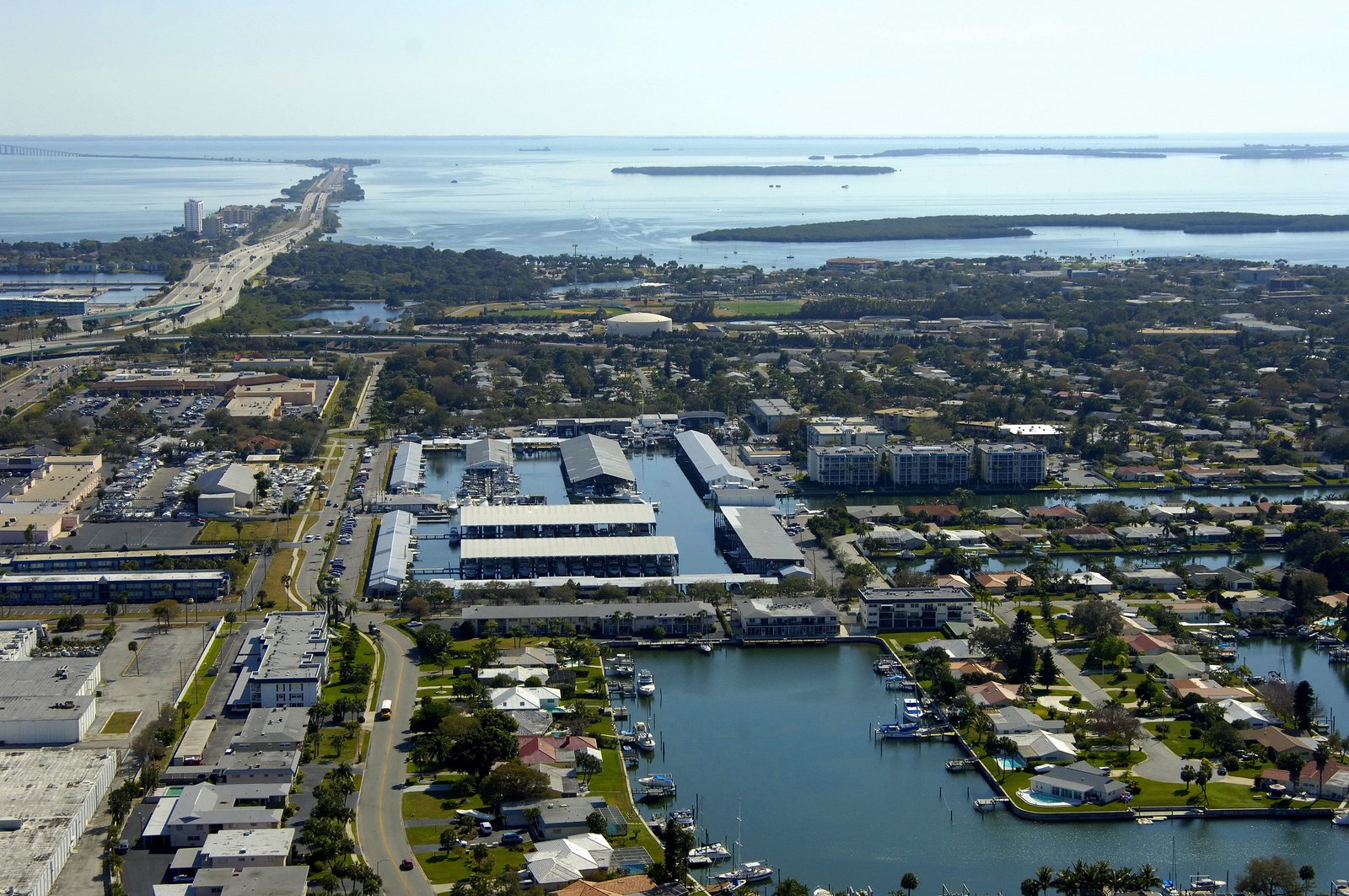
Maximo Point, St. PetersburgMaximo Marina lies about 4.1 miles from Blind Pass, with Pass-a-Grille Channel roughly 4.4 miles off. It sits back from the inlet, and that distance is the single best predictor of how fast a hull fouls here.
At this distance the tidal push has largely spent itself. Water warms, turnover slows, and the balance shifts toward soft growth — slime and grass rather than heavy shell.
A private marina with a settled fleet gives us the most useful thing possible: the same hulls over time, so the cadence gets sharper with every visit.
For a century afterward the land did quieter work: squatters ran cattle, then citrus took over, then the freeze of 1894 pushed growers south and the city started to fill in around it.
1956
By the mid-fifties St. Petersburg had passed 100,000 people and had exactly two marinas — both full, both with waiting lists. Alvin "Babe" Wolosoff had just bought a boat and could not find anywhere to put it.
He and his brother Morty — New Yorkers, both of them — had also just bought several hundred acres. So he built his own, and made it the centerpiece of everything else. By the end of the decade its promoters were billing it as The World’s Largest Covered Marina — and the name stuck for a generation.
Then he did the thing that most people never hear about. The spoil dredged out of the marina basin didn't get barged away — it got spread next door to raise and level the low ground. The dirt that came out of the water became the neighborhood. Maximo Moorings is, quite literally, the hole where the marina is.
To reach open water they cut a canal 3,700 feet long and 200 feet wide, in the years before strict environmental permitting made that kind of work unthinkable. The marina proper opened in 1960 on 44 acres at the head of it. In 1963 it added a service yard with a gantry and a 55-ton travel lift, and started hauling and painting the big stuff.
Timeline
Antonio Maximo Hernandez receives Pinellas shoreline for Seminole War service and establishes a fishing rancho at what is now Maximo Point.
William Bunce joins the operation. Salted fish moves from Boca Ciega Bay to Havana and Key West.
September 25. Water rises to treetop level across the peninsula. The rancho is erased. Both men leave for good.
Babe Wolosoff, unable to find dockage in a two-marina city, decides to build one on land he already owns.
Promoters bill the facility as The World’s Largest Covered Marina. Dredge crews pull muck from the Boca Ciega inlet and use it to fill low spots in the subdivision next door.
Forty-four acres at the head of a 3,700-foot channel. The property would carry more than 300 covered wet slips by the time the rebuild began.
A full service department opens with a gantry and a 55-ton travel lift — haul-outs and bottom work for larger boats, on site.
Under IGY Marinas the timber docks come out entirely, replaced with Bellingham Marine concrete floating docks. The basin is dredged and the fuel system replaced. Slip count is optimized down to 212 to take modern beam — while the grandfathered covered-slip status is preserved.

Things worth knowing
Distance to the nearest inlet is the strongest single predictor of fouling rate. At 4.1 miles from Blind Pass, with Pass-a-Grille Channel a further 4.4 miles off, this berth sits at the edge of it.
St. Petersburg, on Boca Ciega Bay, 4.1 miles inside Blind Pass — well within our regular run.
Growth in Pinellas is not linear, and at 4.1 miles in the seasonal swing is pronounced but predictable. A cadence set for August will be wrong in January.
Bare metal fouls faster than painted surface everywhere on this coast, and even in slow water it leads the hull. Props, shafts and struts usually signal the timing before the paint does.
Manatees, dolphins and grass beds share Boca Ciega Bay. Method matters as much as schedule — media matched to the paint, and nothing scoured into the bottom.
It is one of the smaller operations we cover, and small stable fleets foul predictably.
From the diver
Lower salinity is genuinely hostile to barnacles, and boats kept in a brackish basin often carry noticeably less hard shell than the same hull two miles out. What it does not stop is soft growth. Slime and grass are perfectly happy in fresh water, and they cost you speed and fuel just the same.
Shade slows algae on the topsides and keeps the deck cooler — but it also means less UV reaching the waterline, calmer water, and less flushing under the hull. Covered berths tend to build soft growth more evenly and more quietly than an open slip does.
In a basin like this the hull can look reasonable while the prop, shaft, and struts are already loaded. Bare metal fouls faster than painted surfaces regardless of salinity, so at Maximo the running gear is usually the honest indicator of when it's time.
Gallery
Photography courtesy of IGY Marinas.


We dive the basin and know how it behaves through the season. Tell us the boat and the slip and we'll send a number and a cadence that fits the water it actually sits in.