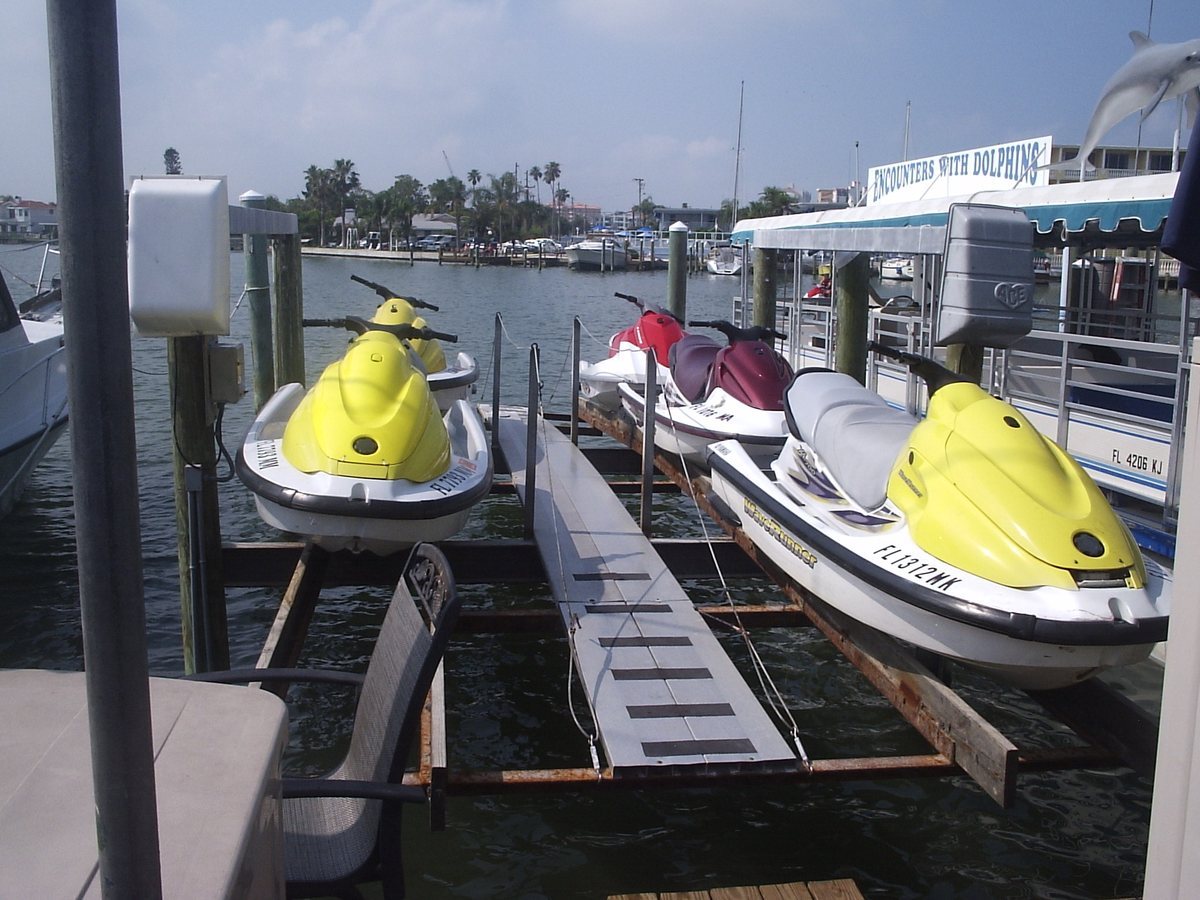
Marinas we dive
Clearwater Beach Municipal Marina, and the water it lives in.
Named 1841Clearwater HarborPinellas
Marinas we dive
The water
Fort Harrison opened on Clear Water Harbor in 1841 as a rest post for soldiers stationed at Fort Brooke in Tampa. The harbour had a name on army maps before there was a town to speak of.
The beach came later than the harbour. This is a city-owned facility at the foot of the barrier island, on water the Army was already charting when Florida was still a territory.
By 1859, Clear Water Harbor had become the first established community on the Pinellas peninsula and received the first post office.
1.5 miles from Clearwater Pass is close enough that the season does most of the forecasting for you. Predictable water is the easiest kind to schedule around.
Clearwater Beach Municipal Marina, ClearwaterClearwater Beach Municipal Marina lies about 1.5 miles from Clearwater Pass, with Dunedin Pass roughly 2.9 miles off. It is close enough to the inlet to feel it, and that distance is the single best predictor of how fast a hull fouls here.
Close to a pass, tidal exchange still reaches the berth but has lost some of its force. Growth is mixed rather than dominated by one thing, and it follows the season more predictably than water further in.
As a city-owned facility it takes a broad mix of boats rather than one class, which means the fouling picture varies more berth to berth than at a private marina with a narrower fleet.
Timeline
The first permanent European settler on the peninsula establishes a farm across at Old Tampa Bay.
The army opens a post on Clear Water Harbor as a rest station for soldiers from Fort Brooke. The harbor gets its name on the maps.
A Category 4 hurricane floods the peninsula, destroys the Egmont Key lighthouse and cuts John's Pass to the south.
The county's first public school opens on land donated by John Taylor — the site of Clearwater High School today.
Clear Water Harbor becomes the first established community on the Pinellas peninsula and gets the first post office.
Streetcar lines knit the peninsula's waterfronts together and beach excursion traffic takes off.
Bridging to the barrier island turns a working harbor into a beach destination.
City-run dockage on a harbor named by the army before Florida had railroads.
Things worth knowing
Distance to the nearest inlet is the strongest single predictor of fouling rate. At 1.5 miles from Clearwater Pass, with Dunedin Pass a further 2.9 miles off, this berth sits well within reach of it.
City-owned, at the foot of the beach. Clearwater, on Clearwater Harbor, 1.5 miles inside Clearwater Pass — well within our regular run.
Growth in Pinellas is not linear, and at 1.5 miles in the seasonal swing is pronounced but predictable. A cadence set for August will be wrong in January.
Bare metal fouls faster than painted surface everywhere on this coast, and in moving water it is relentless. Props, shafts and struts usually signal the timing before the paint does.
Manatees, dolphins and grass beds share Clearwater Harbor. Method matters as much as schedule — media matched to the paint, and nothing scoured into the bottom.
703 Google reviews at 4.6 stars puts this among the busier facilities we cover, and busier basins mean more hull traffic moving growth around.
From the diver
Harbor water moves with the passes, so it is neither as still as a back canal nor as aggressive as the open bay. Growth is moderate and, usefully, predictable.
Position within the harbor matters. Closer to a pass means more flow, cooler water and a slower set; back toward the flats means warmer and faster.
Predictable water is the easiest kind to schedule around. A fixed cadence works well here — the season does most of the forecasting for you.
Gallery


We dive Clearwater Harbor and know how it behaves through the season. Tell us the boat and the slip and we'll send a number and a cadence that fits the water it actually sits in.