Pinellas County · Updated 2026
What dock piling cleaning
actually costs
Piling cleaning is not priced by the piling. It is priced by how much of the piling is underwater, what is growing on it, and how hard it is to reach. Here is the whole structure.
Splash zone
Wetted by spray and wave action only. Algae film, salt crust, light fouling. Reachable from the dock — cheapest surface to clean, and the only zone most homeowners ever see.
WaterlineDiver required below this point
Tidal zone
Alternately submerged and exposed twice daily. This is where barnacles and oysters set heaviest in Tampa Bay, and where trapped moisture under growth does the most damage to wood and the most corrosion to steel.
Submerged zone
Permanently underwater to the mudline. Mussels, tunicates, tube worms, soft fouling. Nobody inspects this zone without getting in the water — which is why it is usually the zone that fails first.
Any quote that does not tell you which zones it covers is not a quote. It is a guess.
This page covers cost. For what the work involves and what an inspection finds, see dock piling & seawall cleaning.

Published price ranges in Florida
Below are the ranges we observe published by Florida marine service providers offering in-water piling cleaning as of 2026. Treat these as the market's stated bracket, not as a quote — providers publish ranges, and the range is wide because the work varies enormously between a two-year-old concrete piling in three feet of water and a thirty-year-old wood piling under a commercial dock in eight.
Light growth · per piling
Algae, soft fouling, thin barnacle set. Straightforward access, shallow water, recent prior cleaning.
$120 – $250
Heavy growth · per piling
Dense barnacle and mussel colonies, multi-year accumulation. Substantially more bottom time per piling.
$250 – $450
Cleaning + documented inspection
Cleaning paired with a written underwater condition report on each piling.
$300 – $600+
Post-storm response
Priority scheduling after a named storm, often with debris removal and structural assessment.
$350 – $800+
On these numbers: compiled from ranges published by Florida in-water service providers in 2025–2026. They are self-reported list ranges, not an audited survey, and no published dataset of transacted piling-cleaning prices in Pinellas County exists that we are aware of. Providers who publish these figures generally do not state sample size or region. Use them to sanity-check a quote, not to predict one.
What Misting Monsoon charges
We quote per dock rather than off a table, because the table above is exactly why a table does not work — the same four pilings can be a ninety-minute job or a half-day depending on depth, growth, and access. What we will not do is give you a range and then revise it once we are in the water.
Tell us three things and we can usually give you a firm number without a site visit: how many pilings, roughly how deep they sit at low tide, and when they were last cleaned. If you do not know the depth, we will ask a couple of questions about your dock and work it out. If the job does not make sense for you — if the pilings are newer than you think, or a cleaning will not solve what you are seeing — we will tell you that instead of quoting it.
What moves the number
How much is underwater
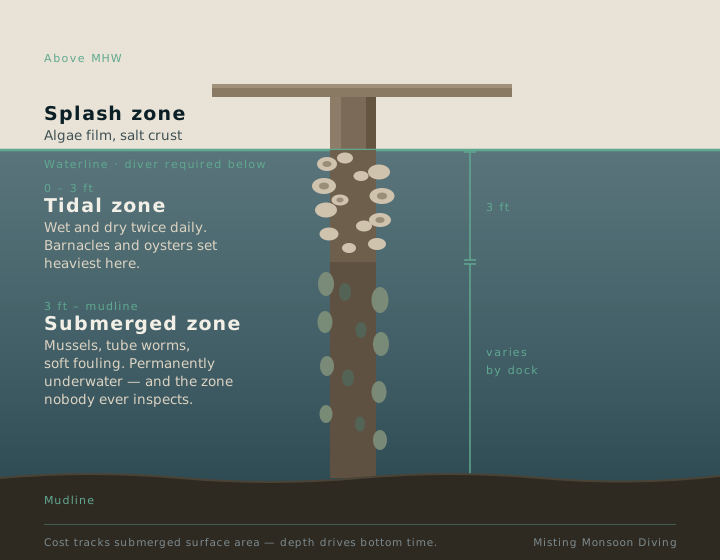
The single largest variable. A piling in two feet of water at low tide is a fraction of the work of the same piling in eight. Depth determines bottom time, and bottom time determines price more directly than anything else on this page. Ask any bidder how deep your pilings run — if they haven't looked, they're guessing.
Time since the last cleaning

Barnacle removal is not linear. A six-month set scrapes off in sheets. A four-year set has cemented calcium bases that have to be worked off individually without gouging the substrate underneath. This is why a dock cleaned on a schedule costs less per visit and far less per year than the same dock cleaned once when it looks bad.
Piling material
Wood, concrete, steel, and composite each take different tools and different pressure. Treated wood tolerates aggressive scraping poorly — gouging strips the treated outer layer and opens the piling to marine borers, which converts a cleaning into a replacement conversation. Steel needs growth off to expose corrosion for inspection but does not need to be brought to bare metal. Concrete is the most forgiving. Composite and wrapped pilings need the gentlest handling of all, because the wrap is the protection.
Access and staging
Whether the crew can work off your dock or has to run a vessel to the site changes the labor cost. Docks inside a marina fairway, under low fixed structures, or with heavy vessel traffic overhead take longer for reasons that have nothing to do with the pilings.
Water conditions on the day
Visibility in Tampa Bay ranges from workable to near-zero depending on wind, tide, and recent rain. Low-visibility work is slower and carries more risk. Reputable operators schedule around it rather than charging you for it — ask how a bidder handles a blown-out day.
Number of pilings
Per-piling cost falls as count rises. Mobilization, setup, and tank changes are fixed. A twelve-piling residential dock has a meaningfully lower per-unit cost than a four-piling one, and a marina with a hundred is a different pricing conversation entirely.
Cleaning versus replacement
The economic case for cleaning is not aesthetic. Marine growth traps saltwater against the piling surface and holds it there. On wood, that sustained moisture plus the physical damage from boring organisms accelerates decay and opens paths for marine borers. On steel, it drives crevice corrosion under the growth where nobody can see it. On concrete, expanding growth works into surface cracks.
Growth also adds mass and drag. A heavily fouled piling presents more surface area to current and wave loading than a clean one, which matters most in exactly the conditions where you need the dock to hold — a storm surge.
Piling replacement in Pinellas County requires a marine contractor, permitting through the county, and in coastal environmental resource zones an additional review for seagrass and mangrove impact. Cleaning requires none of that. The cost difference between maintaining a piling and replacing one is not a percentage — it is an order of magnitude.
DIY: what you can and cannot do
Above the waterline, a stiff brush and a scraper on a pole handle splash-zone algae and light growth fine. Do that as often as you like. It genuinely helps.
Below the waterline is a different task, and the honest reason is not that it's hard — it's that you cannot see what you're doing to the piling while you're doing it. Blind scraping on treated wood strips the treated layer. Pressure washing submerged wood drives water into checks and splits. And you have no way to inspect the result, which means you have no way to know whether the piling you just cleaned has a problem.
Do not free-dive under a dock to scrape pilings. Overhead structure, boat traffic, entanglement hazards, and near-zero visibility are a genuinely dangerous combination, and the fatality reports in this category are real. If it's below the water, it's a diver's job.
What to ask before you sign
- Which zones does the price cover? Splash only, to three feet, or all the way to the mudline. Get it in writing.
- Are you insured and does it cover in-water work? General liability often excludes diving operations. Ask specifically.
- What documentation do I get? Before-and-after imagery per piling and a written condition note is the standard worth paying for. Without it you have no record and no way to verify the work.
- What is your method on my material? A bidder who gives the same answer for treated wood and concrete has not thought about it.
- Is mobilization included? Travel and trip charges are the most common surprise line on a marine services invoice.
- What happens if you find damage? A change-order process agreed in advance beats a phone call from the water.
- What's the recurring rate? If the one-time and recurring prices are identical, the operator is not actually building a maintenance business.
Common questions
How often should dock pilings be cleaned?
In Tampa Bay's warm, high-fouling water, most residential docks are on a six-to-twelve-month cycle. Commercial docks and marinas with continuous vessel traffic typically run shorter intervals. The correct interval for your dock depends on your water depth, flow, and salinity — a canal-end dock with low flow fouls faster than one on open water.
Does homeowners or marine insurance cover piling cleaning?
Generally no. Cleaning is classified as routine maintenance, and maintenance is excluded from standard property and marine policies. Note the inverse, though: deferred maintenance can be grounds for a carrier to reduce or deny a storm-damage claim on a dock. Documented cleaning records can matter after a loss. Confirm specifics with your carrier — we are not insurance advisors.
Is there an environmental issue with removing growth?
There can be. In-water cleaning releases material into the water column, and Pinellas County has coastal environmental resource zones where seagrass and mangroves are present nearby. Ask any operator how they handle debris and whether they're aware of the designation on your address. Pinellas County publishes a lookup tool for this.
Can pilings be cleaned and then protected?
Yes. Wrapping wood pilings in marine-grade barrier material after cleaning is common in Tampa Bay and slows re-fouling and borer access considerably. It is a separate service from cleaning and priced separately. Cleaning must happen first — wrapping over live growth traps it against the wood. Ask us and we will point you to the right approach for your piling material.
Do you clean seawalls too?
Yes. Seawall cleaning and inspection runs on the same dive and is usually quoted together with pilings, because the crew is already in the water and mobilization is the fixed cost. Details on our dock piling and seawall cleaning page, with local pages for St. Petersburg and Clearwater.
What areas do you serve?
Misting Monsoon Diving serves Pinellas County waterfront, including St. Petersburg, Gulfport, Tierra Verde, Treasure Island, St. Pete Beach, Madeira Beach, Clearwater, Dunedin, Safety Harbor, and the surrounding Tampa Bay waterfront.
Get a real number for your dock
Tell us how many pilings, roughly how deep they run, and when they were last cleaned. We'll give you a figure — not a range — and if it's outside what makes sense for your situation, we'll tell you that instead.
Request a quotebeneaththewaterline@mistingmonsoon.com · +1-727-344-9848